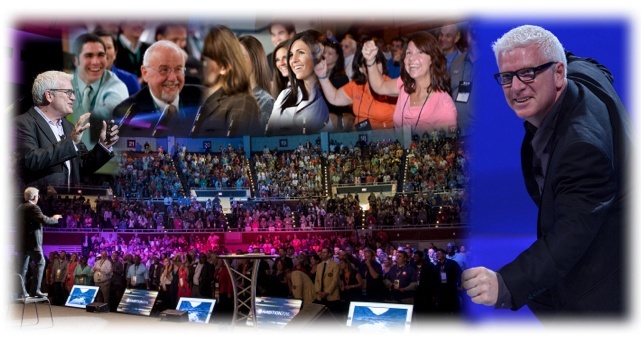


You've seen it happen. Fifteen minutes into the keynote, the laughs get thinner. Arms start crossing. A few phones light up under the table. The event planner in the back row feels their stomach drop because this is the session they fought for budget approval on, and right now it isn't landing.
Every planner who has booked a professional keynote speaker has sat through this moment at least once, wondering if the room will come back or if the next forty minutes will just get quieter.
Why a Flat Room Isn't the Real Problem
A flat room by itself doesn't mean the speaker has failed. Audiences go quiet for reasons that have nothing to do with the content. A late lunch. A previous session that ran long. A room that's too cold or too warm. Sometimes the group is simply tired, and no opening line is ever going to fix that in the first ninety seconds.
The real problem isn't the flat moment. It's what the speaker does in the next sixty seconds after they notice it. A professional keynote speaker who freezes, speeds up out of nervousness, or pretends not to notice will lose the room for good. One who reads the shift and adjusts without breaking stride can bring the energy back before most of the audience even realizes it dipped.
This is the difference event planners are actually paying for, even if they don't always know how to describe it in a speaker brief.
What Separates a Professional Keynote Speaker From an Amateur in That Moment
Most speakers can deliver a polished opening. Fewer can handle the fifteen-minute mark when energy dips and the plan on the page stops matching the room in front of them. This is where Vince Poscente brings something most speakers can't fake: an Olympic-trained relationship with recovery.
Vince spent years as a competitive speed skier, a sport where one flinch or one late reaction at high speed ends the run. Athletes at that level don't get the luxury of pausing to think about what went wrong. They train a specific skill: noticing the shift instantly and adjusting mid-motion, without losing control. That same instinct is what separates a keynote speaker who can rescue a quiet room from one who simply hopes it fixes itself.
It isn't about having more energy than the room. It's about reading the room accurately and responding with precision instead of panic.
The Four-Point Recovery Framework
When a room goes flat, the speakers who recover well tend to follow a similar internal pattern, whether or not they'd describe it this formally.
Here's what that pattern looks like, broken down into four parts:
1. Read the Room Without Panicking
The first skill is noticing early, before the dip becomes obvious to the whole room. A speaker watches for small signals: fewer eyes making contact, slower laughs, more phone checks. Catching this at minute twelve instead of minute twenty-five makes the recovery far easier. Panic at this stage almost always makes things worse, because audiences can feel a speaker's discomfort even faster than they notice their own.
2. Reset the Pace
A common mistake is trying to fix a flat room by talking faster or louder, as if volume alone can force attention back. It rarely works. The better move is slowing down, shortening a sentence, or dropping in a short pause. A confident pause signals control. It tells the room, without saying it out loud, that the speaker is still steering the session.
3. Use Silence as a Tool, Not a Threat
Most speakers are taught to fear silence. A seasoned speaker treats it differently, using a deliberate pause to pull attention back rather than filling every second with words. Silence after a key point often does more work than another five sentences explaining it.
4. Return to the Core Message
When energy dips, the instinct is often to add something new to win the room back: a joke, a tangent, an extra story. The stronger move is usually the opposite. Returning to the single core idea of the talk, restated simply, tends to re-anchor a distracted room faster than anything unfamiliar.
Standard Reaction vs. Professional Keynote Speaker Reaction
|
Moment |
Standard Reaction |
Professional Keynote Speaker Reaction |
|
Energy starts to dip |
Talks faster to fill the gap |
Slows down and shortens the point |
|
Audience goes quiet |
Fills the silence nervously |
Let's pause to do the work |
|
A joke falls flat |
Apologizes or over-explains it |
Moves on without drawing attention to it |
|
Ten minutes of low energy |
Adds new material to compensate |
Returns to the core message and simplifies |
|
Session ends flat |
Rushes the closing |
Rebuilds momentum before the final minute |
This is the kind of composure event planners remember long after the event, even if they can't always name what they saw happen on stage.
How Vince Poscente's Background Shapes This Composure
Vince Poscente's approach to a flat room isn't a trick he learned from a speaking coach. It comes directly from an Olympic career built on split-second recovery, and it shows up in how his keynotes are described on his own site: energetic, innovative, and powerful, three qualities that only mean something if a speaker can sustain them even when a room resists.

His talks are also built around a clear idea: "Do what the competition isn't willing to do." Staying composed when a room goes quiet is exactly that kind of unglamorous discipline. It's not the part of a keynote that gets applause on its own, but it's the part that determines whether the rest of the session works.
Vince's keynote topics reflect this same principle in different forms:
- FULL SPEED AHEAD — Built for high-energy openings and closings, where momentum has to be earned, not assumed.
- CONFIDENCE ON COMMAND — For moments when results-at-speed matter most, including recovering composure live on stage.
- WINNING MINDSET — Practical, repeatable takeaways rather than a one-time energy spike.
- PEAK PERFORMANCE SAFETY — Proof that his frameworks hold up even in serious, high-stakes rooms, not just high-energy ones.
If you want to see this composure in action rather than just read about it, Vince's event videos show how he holds a room's attention across a full session, not just the first five minutes.
When Should You Ask About This Before Booking?
Most event planners don't think to ask a candidate speaker how they handle a flat room until after they've already had a bad experience with one. It's worth asking earlier.
Before booking any keynote speaker, ask them directly: what do you do when the energy in the room isn't matching your opening?
Their answer tells you more about how the actual event will go than any highlight reel can. A speaker who has a real answer, grounded in something they've lived through, is a very different bet than one who says "that's never happened to me."
If you're weighing this for an upcoming conference, association meeting, or franchise convention, it's worth a direct conversation. Vince and his team also offer bulk book discounts for events bringing his book to attendees, which is worth asking about while you're comparing options for your corporate event.
FAQs
Q1. What should I look for if I'm worried my audience might be hard to energize?
Ask any candidate speaker how they've handled a flat room in the past. A professional keynote speaker should be able to describe a specific moment and what they changed, not just reassure you it won't happen.
Q2. Is a flat room usually the speaker's fault?
Not always. Timing, room temperature, and a heavy schedule earlier in the day can all flatten energy before the speaker even begins. What matters is whether the speaker can recover it.
Q3. How fast should a good speaker recover a low-energy room?
Experienced speakers usually notice within the first few minutes and adjust immediately, often before most of the audience consciously registers that anything has shifted.
Q4. What's the best way to evaluate this before signing a contract?
Watch the full-length video, not just a highlight reel, and ask the speaker directly about a time a room didn't respond the way they expected.
Conclusion
A quiet room isn't a red flag on its own. What it reveals is whether the speaker you booked can recover without losing the audience for good. That composure, built the same way an athlete trains for split-second recovery under pressure, is exactly what separates a forgettable session from one people are still talking about weeks later.
If your next event needs a professional keynote speaker who can hold a room even when it doesn't respond the way you hoped, book Vince Poscente or call 214.335.0856 to talk through what your audience actually needs.