Vince Poscente

Recent Posts

Young Noggin' Power - Motivational Insights from Youth

Posted by Vince Poscente on Thu, Dec 06, 2012 @ 12:19 PM

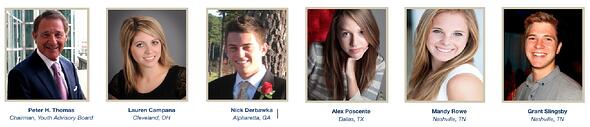
On the surface, they have what they need to succeed. Thomas Franchise Solutions has a seasoned board of advisors, a sure-footed leader and committed staff, driven for growth. But, their founder and Chairman, Peter Thomas, wants more. A fresh, unconventional perspective. His brainchild, a Youth Advisory Board.

A Youth Advisory Board is not new to organizational development.

State Farm has a youth advisory board. Thirty 17-20 year olds are assigned to address issues important to State Farm and communities across North America. Their service-learning projects help State Farm with a local presence and goodwill.

Brewerytown in Philadelphia has a community Youth Advisory Council comprising of 14-19 year olds. Yours truly even got in the youth activism game thirty-five years ago. I chaired a Teen Board that complimented the adult efforts of the Strathcona Youth Association’s mission to build a local teen center.

The Alberta Children's Hospital in Calgary has been using advising youth for years. According to avid supporter, Eric Perrault, "The Children's Hospital in Calgary (the big lego block) was based upon designs from our youth advisory. Not only were they consulted in the design phase, all structural and programs had to go through them for changes and approval. This may explain why the facility is one of the best of its kind."

TFS takes the Youth Advisory Board concept outside the somewhat insular corporate playground.

What’s innovative about Thomas’ Youth Advisory Board is their assignment. To submit a SWOT analysis (strengths, weaknesses, opportunities and threats). The youngest member is in middle school. Others are either in high school or college. The youth selected are armed with an entrepreneurial acumen and intellegence oozing with curiosity.

As it turns out, there are many check marks in the win category for TFS and the youth.

Win #1 A Younger Lens for a Bigger Picture - TFS gets to see through a younger lens. TFS's model of investing in franchise companies with a proven track record and profitable model could be strictly numbers driven. But Thomas wanted to augment his investment process with insights of those who the corporate world normally would rather have share of wallet share… not what the young minds have to share. Meanwhile, the youth know they need to look carefully at what they review and translate it for their elder colleagues.

Win #2 Simple Sophistication - The youth dive into the real corporate conversations. By being added to weekly internal communications and other information flow the youngsters gain insight into how bottom line results are driven by organizational decision-making. TFS forces themselves to keep their messaging easy to digest and uncomplicated. The keep-it-simple mantra is self-imposed while paying dividends.

Win #3 Evoking Insights and Outsights – TFS wants to scan for new franchise opportunities while balancing the demands of growing their partner companies. It is incredibly easy in any organization to get caught in the manage-what-we-have cycle at the expense of innovating towards new frontiers. To ignore dealing with change and managing change companies like Radio Shack and Blockbuster have fallen victim to this phenomenon. With the Youth Advisory Board’s consistent input, everyone at TFS pauses to reflect and seek beyond themselves.

Consider eliciting the noggin’ power of a few sharp, still developing, under 25 brains. Go beyond traditional focus groups or surveys. Create a youth advisory board and evoke a bigger picture with simple sophistication. A fresh, unconventional, youthful, motivational perspective may be exactly what you need.

Tags: Goals, Motivational, Business Leadership

When is the Gig Up? Motivation for Change

Posted by Vince Poscente on Thu, Nov 29, 2012 @ 01:57 PM

When is the Gig Up?

  1. If you’ve lost your expertise or the gig doesn’t light you up, get off the field and coach.
  2. If the coach speaks, shut the pie hole and listen. What (s)he knows is invaluable.

Bob Dylan (71) gave one of the worst concerts we’ve ever seen - ever! Paying hundreds of dollars to see a legend had the, “I saw him perform” equity. But his performance was embarrassing. Replace the band with an expert interviewer and people would get a whole lot more out of their investment. (Subtitles needed.)Chuck Berry (86) was happy to still be performing, he repeated songs, was completely confused at one point - yet the crowd loved that he was there and even do a version of the duck walk. Did we put a notch in the, “I saw him perform’ punch card? Yes. Was it professional musicianship? No. Put a spotlight on him and hear about all his shenanigans from 50’s and 60’s or advice from his years of experience – how cool would that be?
Paul McCartney’s (70) concert wasn’t bad, but not worth $250 a ticket. It was obvious Sir Paul “mailed it in.” He seemed unenthused and tired. Yet, give him a stool where he can tell Beatles stories – THAT would be entertaining.

Guys, if you’ve lost your expertise or your gig doesn’t light you up, get off the field and coach.

But, there are no guarantees in coaching.

Brian (60+) sold his chain for millions to a large restaurant conglomerate. They invited him on their board but consistently ignored his input. The younger voices in the boardroom thought they knew better.

Leon (70+) sold his restaurant chain in the midst of a dramatic growth curve. The current owners took the chain off its successful path - until they brought Leon back as a consultant. Revenue has improved.

Egon (60+) has enough money to retire. But he wants to share his wisdom. He is offering consulting – for free - to a lucky company who needs his ‘turn-around to quality’ expertise. His passion is helping people.

Guys, if you have it in you, we want to learn from you. We want to hear your voice and apply what we gain from your perspective. If you have that spark, let’s see it. It lights us up as well.

Of course there are many exceptions…

Wanda Jackson (75) has arthritis and charisma all at once. She captivated her fans with stories about Elvis and her songs that ushered in the age of rock and roll. Her voice strained past her big-as-the-South smile. The intimate crowd loved it.

Peter (74) started Thomas Franchise Solutions within the last couple of years. He is on fire. He’s enthusiastic and a driving force. He belongs in the captain’s chair and provides both the wisdom and the spark to make great things happen. He’s more fit than most 50 year olds. His passion is infectious. He’s in the game, loves the gig and belongs there.

To Bob, Chuck and Paul… thanks for the memories but you're not getting any more concert money from those who expect more.

Tags: Self Development, Motivational, Business Leadership

Election Results - Motivating Politicians

Posted by Vince Poscente on Wed, Nov 07, 2012 @ 05:30 AM

We either ignore, complain or take action when our politicians make a choice. There is one more option: Stay on their horribly-low-approval-rated-butts and make sure they make choices for the people, not the political party or self-interests. This involves a new order of involvement (easier offered than accomplished - but still doable and ultimately necessary in today’s environment of distrusted politicians).

Before the economy turned south in 2008, yours truly hated looking at the numbers. My motivational speaker filtered eyeballs would glaze over at a P&L statement. With a form of numerical dyslexia… words like “budget” actually spelled “snore.” Tax forms made noises like “blah, blah, blah.” Bank statements resembled leaflets for garage doors or lawn care.

That all changed when we had to get serious about finances. The luxury of sitting on the unaccountable porch swing, sipping the sweet ice tea of ignorance was no longer an option.

In the last four years my order of involvement surrounding numbers and finance changed… for the better. It was as if a new sheriff was in town. I got accountable on accounting.

The same, order of involvement surrounding politician accountability and the elimination of citizen ignorance is waiting for us. Do this and your representative will know there’s a new sheriff in town – that sheriff is you.

Here are 3 Do’s to monitor what your political representative(s) are doing for you:

  1. Track your representative on Google Alerts . You will be able to follow what he or she is being reported on. If they are representing your interests, you’ll know pretty quickly. If they are blocking progress, climb all over that low-approval-rated-butt. In the US – here is the link to find who your representatives are .
  2. Follow your representative on Social Media. Facebook Pages and Twitter work well. If you see something amiss, write them. Post questions about it. Ask questions without publicly jumping to conclusions. Be forceful in getting right with the answers you hear.
  3. Get on two email subscriber lists – the representative’s and the political watchdog of your choice. Again, question without judgment. Keep asking questions to get answers. Make those answers public in your own way.

Here are the 3 Don’ts:

  1. Do not follow media outlets with political agendas. You’ll only be hearing a biased point of view. Let’s leave brainwashing up to the North Korean government.
  2. Don’t trust pundits who use anecdotal evidence or sound bites as universal fact. If you fall into their narrative you’ll be limiting your own voice.
  3. Absolutely do not forward emails that polarize or demean. Keep your eye on the prize: Positive results are the solutions you seek. Choosing to destroy someone’s character only throws gasoline on fires of distrust and fear.

Those in the free world have a freedom of rights but not a freedom from responsibility. Hop off the porch swing. Put down the sweet iced tea. Jump into a new order of involvement and seek true, sustained election results.

Please "Like" us on Facebook

Tags: Goals, Business Leadership

The Right Amount of Adversity - Even for Motivational Speakers

Posted by Vince Poscente on Mon, Nov 05, 2012 @ 04:23 PM

It took 36 hours of mind numbing air and car travel to reach the trailhead. Our destination? One of the most remote places on earth. We would be the first documented Westerners to ever hike up this Himalayan Sikkim reserve. While each trekker faced his or her own imaginary and physical limitations, we ultimately experienced what was required - the right amount of adversity.

Thirteen months prior, a devastating earthquake changed the map in these brittle mountains. Small villages vanished and lives were lost in landslides. As the world’s third tallest peak watched over the juxtaposition of surrounding jagged peaks and its gentle Lepchan inhabitants, we climbed into rarified air of magnificence.

Anthropologists have yet to determine the origins of the Lepchans living in this land surrounded by Nepal, Tibet and Bhutan. Lepchans live off the land and are enormously caring and trusting. They were our guides and porters. The Lepchans we trekked with were nothing short of angels appearing surreally when treacherous footholds gave way.

Nature can be the lazy man’s teacher, yet combined with a people of extraordinary presence; the education was all around us. Together we ascended through leech filled jungles and abandoned monasteries. Following the footsteps of the mythical wizard Padmasambava, we touched the shores the sacred Keshong Lake at over 15,000 feet above sea level.

On the most physically challenging part of the trek we climbed 50-degree switchbacks, ascending over 3,000 feet from dense forest to frigid environs above the tree line. At one point, I looked back to Jeff Salz who said, as sweat framed a sparkle in his eyes, “This is the right amount of adversity.”

In some cases, adversity is flat-out entertaining.

On a moonless night, with headlamps piercing the basecamp darkness, three of us brushed chattering teeth. The chill vanished in a heartbeat when we saw a fellow trekker struggle to stay upright in the aptly named ‘poop tent.’ With a flimsy nylon structure, only large enough to house a chair with a hole in it, our climbing buddy started to imitate a scene out of Alien. His headlamp flirted with undulating shadows of elbows, knees and feet flailing to prevent the tent from falling over. Note: Witnessing this kind of adversity makes toothpaste blow out your nose.

Each of us faces adversity.

Some adversity can torture you with sleepless nights. Some is so great your knees may buckle.

But know this: Adversity is the wellspring of wisdom. It’s the foundation of character. Without adversity, your inner power atrophies and your moral compass can lose true north.

It took a great deal of time and effort to put ourselves in a place of hostile temperatures, uncertain terrain and thin air, but we did it. We climbed, not because it was there (or reaching a bucket-list goal for a motivational keynote speaker), but to fill our lungs and soul with the restorative impact adversity can have.

During the struggle it was difficult. Looking back is was an adventure of a lifetime.

Is it time again for you to climb past hardship?

You’ll find the adversity is just the right amount.

Tags: Goals, Motivational

In the Middle of Now Here - Motivational

Posted by Vince Poscente on Tue, Oct 30, 2012 @ 09:07 PM

It would be insulting to your hosts if they found out you had said, “Hello, from the middle of nowhere!” At the moment of the release of this eBrief we (a group of adventurers) are trekking through the remotest parts of the Indian Himalayas, and our hosts are a few snow leopards and mountain goats. They wouldn’t be offended by the affiliation with ‘nowhere’... Yet, in this case, ‘now here’ is a state of mind worth considering.


In 2006, Jeff Salz led a group of Westerners up a sacred valley within the newly minted Great Himalayan Nation Park. The quest we sought was to summit the yet unclimbed Chakri Peak. Three years later, Jeff handed off the expedition lead to me for a summit attempt of an unnamed mountain. Due to unstable snow, our summit attempt was halted, but we went on to explore fascinating communities near Tibet.

Now, we’re back to another region of the Indian Himalayas for a different adventure; the Sikkim Valley and the Lepchan people. The snows have come early. Temperatures will drop well below freezing. After five days of steep, wet climbing we will spend a couple of days staying with the people of this isolated culture in India near the Tibetan/Nepalese borders.

Let’s explore the concept of “now here.”

One, a trip like this is a chance to reboot. It’s not much different from switching a computer off, then on, to allow the hardware to reconfigure and function better. Getting off the grid – checking out of society – being immersed in an unencumbered break is healthy for the mind and body.

Two, climbing forces you into the moment. When each step counts in the category of safe or life threatening, it forces you to pay close attention to the moment. We will be in the far reaches of mountainous elevations. There is no technology - only a good foothold. Being in the moment for extended periods of time can erase the worries of past and future.

Three, adventure is the jalapeno in your chili. The security of monotony can addictive. By visiting a small society isolated from the trappings of the age of speed is a way to force variety into life. It was not easy to get to India given responsibilities at home, work and the sheer distance travelled. Yet, at the time of writing this, I can promise you, “We’re not in Kansas anymore Toto.” Break your routine. Break it often.

By being here – now you release the obvious drag the past or the future can have on your psyche. Yet, being present, when forced on you by your environment, can be a true catharsis. Take daily breaks of meditation to allow your brain to reboot, your thoughts to transcend time and your perspective to be energized. Take longer breaks like holidays or time-off to do the same for lasting influence on your brain, thoughts and perspective on life.

Motivational Incentives - Escape Fire on US Healthcare

Posted by Vince Poscente on Wed, Oct 03, 2012 @ 09:47 AM

Escape Fire is a term and a documentary. Both are worth knowing about, and just might be the motivational incentive you need.

The term, “escape fire” is an intentional fire ignited by a fire crew, usually in a forest or grassland, to escape a dangerous situation. If a forest-fire crew realizes they might die in an oncoming fire, they can survive by burning out an immediate area, so the original fire can burn past them.

Then, there’s the Escape Fire documentary.

There are wonderful people IN the healthcare system. Despite that:

  • 30% of healthcare costs in the U.S. do not actually improve health.
  • 75% of American healthcare costs are spent on preventable diseases.
  • $1.1 billion was spent lobbying Washington on healthcare between 2009 and 2010.
  • Soldiers’ use of prescription drugs has tripled in the last 5 years.
  • The more a drug is marketed to physicians, the more likely it is to be prescribed in America.
  • The US is 1 of only 2 countries that allow pharma companies to advertise straight to consumers.
  • 40% of hospitals have fast food restaurants on their premises.

ESCAPE FIRE: The Fight to Rescue American Healthcare tackles one of the most pressing issues in the U.S.: What can be done to save this country’s broken medical system? This summer, I saw this award-winning documentary at the Dallas Film Festival. I haven’t been able to stop thinking about it.


The film followed compelling human stories, as well as leaders fighting to transform healthcare at the highest levels of medicine, industry, government, and even the U.S. military. What was striking about the film was its ability to skip past the political healthcare debate and go directly to solutions. "ESCAPE FIRE is about a way out. It’s about saving the health of a nation."

One message in Escape Fire was change the incentive and you change the results. In American healthcare, the incentives center on treating disease – treat more disease and make more money. Corporations will always go where the money is.

Beyond compensation, where does your organization focus its incentives?

We know that regular breaks are good for the mind. But are there incentives to take a break? We know fresh food is part of a balanced meal. But is fresh food a compelling option at the workplace? We know regular exercise is important. But are there fitness incentives provided where you work?

Creating an escape fire initiative at work is a dramatic, yet effective way to thrive in a system designed to keep things just the way they are. Institute “Break Bucks” for people to actively ‘sharpen the saw’ with regular breaks. Keep a bowl of fresh fruit and veggies in the break room. Secretly put an apple on your colleague’s desk. Start an exercise team. Set fitness goals together. Keep each other accountable.

One way or another, an escape fire might be the incentive you need.

Vince

PS ESCAPE FIRE: The Fight to Rescue American Healthcare will be released on October 5th in select theaters, on iTunes, and via Video on Demand. ESCAPE FIRE premiered at the 2012 Sundance Film Festival and has gone on to win numerous film festival awards nationwide.

Birthday Wishes

Posted by Vince Poscente on Sun, Sep 30, 2012 @ 08:53 PM

Thank you all for the birthday wishes today :-)

Oh... and did you know... we have a tradition in our house about blowing out candles and the whole 'secret wish' thing.

Why on earth would you keep your wishes a secret?

Instead, we tell as many people as we can what our wish was when we blow out the tiny wax sticks in flames...

Happy Birthday and may your wishes come true.

My wish is to have you LIKE my facebook page... thanks for the gift of your clicking index finger!


describe the image

SEO Strategy: Lean Copy Wins Every Time

Posted by Vince Poscente on Tue, Sep 25, 2012 @ 05:17 PM

I came across this newsletter and thought of you. Enjoy...

Want to optimize your web content to get the best web engine rankings? One of the most overlooked ways is to edit your content so that every sentence is clean, clear and succinct.

Best practices:

Screen Shot 2012 09 25 at 5.23.34 PMKeep word choices, sentences and paragraphs short, simple and to the point. Remember, most people do not actually read web copy, they scan it. Therefore, simplicity is essential.

Always put your reader and the action you're asking your reader to take first. Put everything else second.

Drop any words or phrases that do not add to your meaning. Edit out clichés.


Here are seven common mistakes followed by cleanly edited alternatives:

Example #1:

Wordy: By clicking on the icon you're not only able to make reservations by e-mail, you can also download a map and directions to the location.

Edited: Click on the icon to request reservations and download directions.

Example #2:

Wordy and clichéd: If you're looking for hot deals on cool ski packages, visit (website address).com.

Edited: For the best ski vacation deals, visit (website address).com.
Or:
Edited: Visit (website address).com for the best ski vacation deals.

Example #3:

Wordy and clichéd: Before you make up your mind who you're going to pull the lever for in the voting booth in November, look up what each candidate stands for on this chart.

Edited: Before deciding for whom you'll vote, compare each candidate's position on major issues. (Note: Place the hyperlink on the word "compare.")

Example #4:

Wordy: To update your existing password for a new one, start by clicking on My Account on your Member page.

Edited: To reset your password, go to My Account (on your Member page).

Example #5:

Wordy and clichéd: If you want to track statistics of your fantasy football team from week to week, sign up for "Mega-Fan Rights" and build graphs that compare any two stats to your heart's content.

Edited: Click on "Mega-Fan Rights" to generate graphs that compare two statistics.
(Best Practice: Eliminate sentences that begin with the words, "If you want to∑" Usually begin with the action, "Click on..." Note: There are cases where you might want to begin with the benefit your user will get out of taking the action and then follow up with the action.)

Example #6:

Wordy: You can purchase money-saving coupons by clicking on the dollar-sign icon
Wordy: If you want to purchase coupons, just click on the dollar-sign icon.

Edited: To purchase money-saving coupons, click on the dollar-sign icon.

Example #7:

Wordy: Your iPhone comes with a downloadable emergency contact application that allows you to call all your e-mail contacts from any web-enabled device.

Edited: The emergency contact application lets you call your e-mail contacts from any web-enabled device.

Written and authorized use by Chuck Lustig

Chuck Lustic says: If you want to improve the business value of your website, make sure your copy is crisp, clear and to the point. (Note: Read this and other EWAs on my blog at http://excitingwritingblog.blogspot.com)

Copyright, Chuck Lustig, 2012

Tags: Business Leadership

Tumbleweed on the Global Economy

Posted by Vince Poscente on Sat, Sep 15, 2012 @ 05:03 PM

“Don’t look at me!” became the mantra around Tumbleweed. Tumbleweed’s example could teach us something about the global economy.

Tumbleweed was the worst speed skier ever. His pseudonym came from his uncanny ability to crash in the exact location of onlookers.

motivational keynote speakerTraining at Fortress Mountain was a weekly event. A dozen speed skiers would convene on the third chute on any given weekend. Tumbleweed got his nickname because he would regularly catch an edge, followed by a spectacular ability to cartwheel down the slope.

The first time he crashed not everyone was looking. But the yelps from fellow skiers alerted the impending wreck. Skiers would scatter in all directions, as Tumbleweed would careen into a collection of hastily discarded gear.

The next time Tumbleweed perched at the top of the training run, all eyes were glued. Everyone had a morbid fascination with seeing a wipe out and Tumbleweed proved capable of satisfying that need.

Again, high up the slope, Tumbleweed managed to hook an edge and give a pretty amazing show. He headed straight for the on looking racers. Again it took us by surprise. We attracted Tumbleweed like a ball bearing to a magnet.

In the lodge we talked at length about our newfound mascot. We named him Tumbleweed. He seemed to like it. We agreed we’d never seen a speed skier capable of crashing in the exact direction of the racer compound. It wasn’t coincidence. It had to be something else.

Conclusion: It was where he was looking when he started to crash. He was looking at us.

The next day he crashed again (the guy had to be made of rubber, especially between the ears). Even though we moved the compound well out of the way, we stood at the ready, with ski poles positioned to release our bindings and gallop away.

As if it were slow motion, Tumbleweed looked at us as he launched into the tuck position. “Don’t look at me!” yelled Laurent.

Too late. Tumbleweed didn’t even get pointed straight when he tripped up over his own skis. As if defying physics, Tumbleweed plowed into our promptly vacated area.

Tumbleweed got up. Shook himself off like lumpy bird in frigid birdbath and grinned.

Tumbleweed’s example has a lot to do with how you run your business or drive sales. It’s impossible not to hear news about shaky consumer confidence, impending inflation, entire countries going bankrupt and general uncertainty.

As individuals, the best thing you and I can do is pretend the economy is saying, “Don’t look at me!” Let’s leave the looking up to economists (who make stuff up on a regualr basis).

Instead, keep your eye on the prize. Whatever your industry and however small the pie has become, there’s still pie in other market segments. A changing landscape, new oppotutnity, yet-to-be-discovered revenue channels... THAT is what you must look at.

Finally, if you are competitor of mine, “Don’t look at me!” Run out. Buy a newspaper. There all sorts of things you can crash into.

Tags: Motivational, Business Leadership, Inspirational

Circle Power - A Motivational Keynote Speaker's Perspective

Posted by Vince Poscente on Wed, Sep 12, 2012 @ 05:15 AM

motivational circlesIt wasn’t the fire pit that elicited that feeling. It wasn’t the crooning brook hugging the perimeter either. Even the comfy teak rocking chairs in the fresh autumn air weren’t the source. The pivotal reason our backyard fire pit was such a special, therapeutic place was simple – circle power.

In the Native American culture, circles encompassed their existence. According the writings of the Oglala Sioux Holy Man, Black Elk, the “Power of the world works in circles, and everything tries to be round.” He referenced nature's four seasons, the sky, birds nests and “the circle from childhood to childhood, and so its in everything where power moves.”

In the 19 th century, Monet, Renoir and Degas consistently met with fellow artists to discuss their craft, exchange ideas and better understand their industry. They attributed their success, and the rise of impressionism, to these power circles.

Carl Jung was the first person to identify circle power as an archetype of integration and wholesomeness. He determined the circle model as much-needed medicine for social and psychological disintegration.

At home we have the perfect space for a round dining room table. The profound difference between a squared off table and a round one was immediately obvious. The backyard fire pit was no different.

Boxy homes with boxy rooms dictate the dissociative undercurrents of sitting at a right angle to someone else. Turn the dynamic into a circle and the energy is amplified. Boardrooms across the globe miss the opportunity to elevate the level of engagement, exchange and even innovation with the cornered-table environs.

Scott Belsky, author of Making Ideas Happen supports this approach. “The most successful circles are made up of people who have a shared commitment and are willing to keep a set of rules.” Teamwork communication expert, Mark Taylor describes the “Power of threes” as a vast communication improvement. He points out the impact of two person exchanges are dwarfed by the influence additional perspectives have on a discussion. With a circle, the power of connection and new ideas spring forth.

The circle power dynamic is also palpable in conference or event settings. When conference planners ( such as our clients - Hampton Inns or Campbell’s) configure the room in a circular fashion the energy in the room jumps. Don’t let a hotel worker arrange the chairs as a squadron of militaristic, straight rows. Theater-style completes a circle with the stage. Look no further than comedy clubs to understand how this kind of seating around the stage results in souped-up energy and giddy crowds.

Circular seating is comfortable. It promotes active listening. It even transcends time and space. The outside world is irrelevant for those precious moments where everyone is equal and joined in a healthy union.

Now, if you were one of the eight people who enjoyed our fire pit last Saturday night, this might be more analysis than necessary. Basically, it felt good to gather friends in a circle.

Tags: Motivational